KN-86 DECKLINE — FIELD DISPATCH
TRANSMISSION 01 / 24.04.26
The deck starts talking to itself.
You're in.
This is the first Field Dispatch — a build log from a hardware project called the KN-86 Deckline.
Here's the short version: I'm building a handheld terminal. It has mechanical keys, an amber monochrome display, a sound chip from 1988, and a cartridge slot that changes what the device can do. You type on it. You run missions on it. The screen looks like a piece of equipment from a movie that was never made.
My name is Josh Schairbaum. I'm building it through my studio, Great Western Productions. The fiction says a Japanese company called Kinoshita Electronics Consortium designed this thing in 1988 and never manufactured it. The truth is I found that story interesting enough to make the hardware real.
Every Friday, I send one of these. They cover three lanes: what shipped on the device, what the fiction is doing, and whatever piece of design work is worth a few minutes of your time. If a week produces nothing, you won't hear from me.
Here's what happened this week.
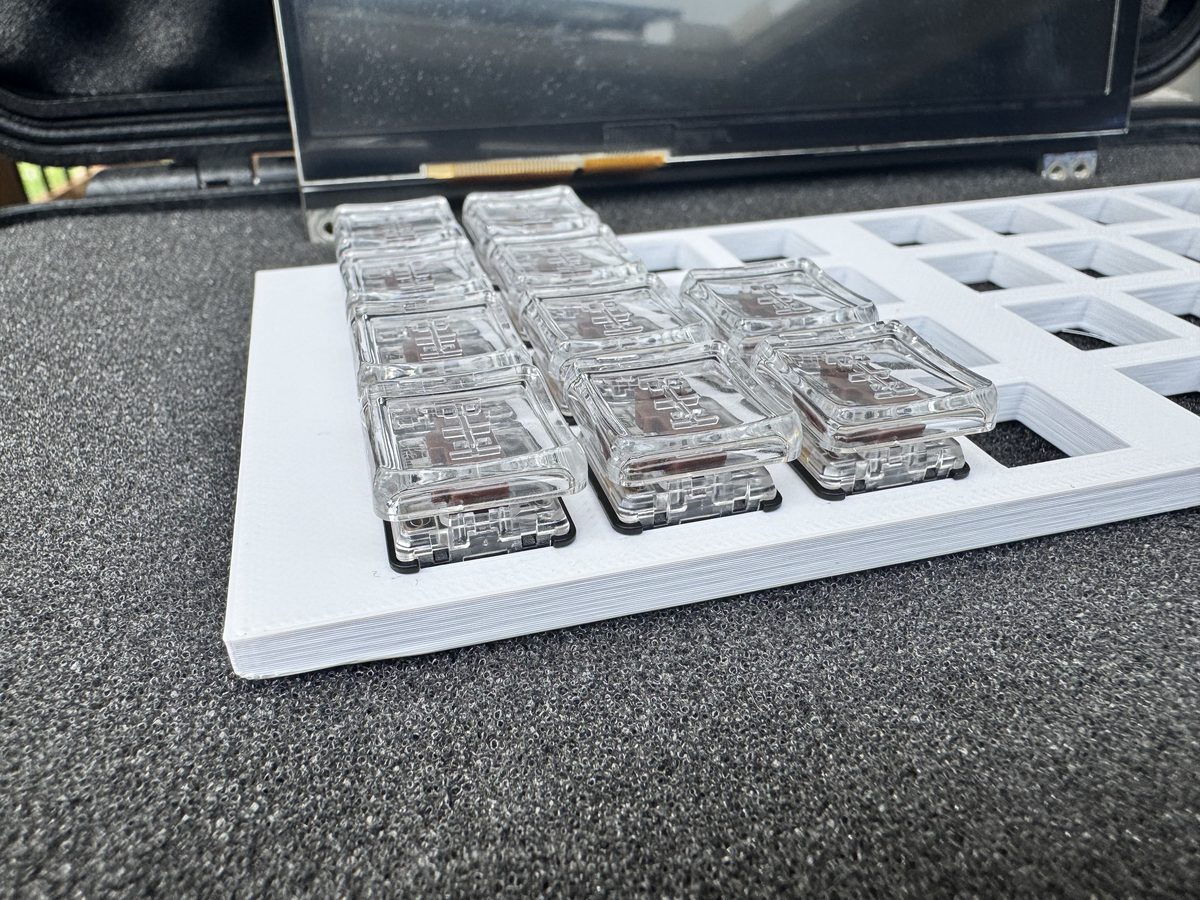
FIRST KEY PLATE DRAFT — CHOC SWITCHES, EARLY 30-KEY LAYOUT. SINCE REPLACED BY THE 34-KEY SPLIT.
BUILD LOG
The deck starts talking to itself.
The prototype runtime now boots into attract mode.
If you slot no cartridge and let the device sit idle, it used to show a black screen with a blinking cursor. That felt wrong. Every piece of consumer electronics in 1988 — the arcade cabinets, the demo kiosks, the store-display Amigas — knew how to fill dead air. They performed for themselves, loudly, hoping you'd walk by.
So I built that back. The deck now plays pre-rendered amber sequences when idle: hero animations for ICE Breaker, Depthcharge, and the other launch titles, cycling at 30fps with audio from the YM2149 sound chip. Drop a cartridge in, the demo yields. Take it out, the demo resumes.
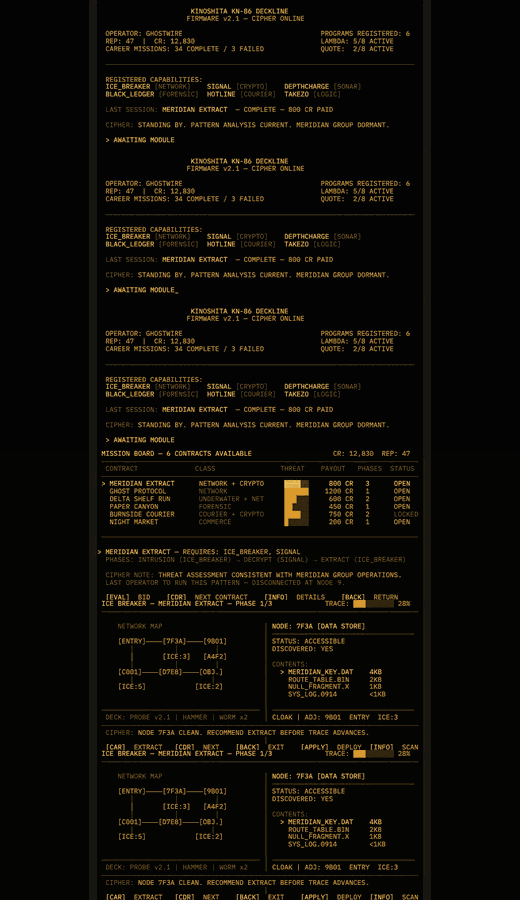
BARE DECK TERMINAL — ATTRACT MODE IDLE STATE
The format shipped alongside it: .kn86demo — a small binary container for attract sequences. A 30-second loop fits in about 35KB. The player is ~200 lines of C. Authoring happens in TypeScript (scenes render in Remotion), then a scene-to-binary tool compiles them down to the device format. Same bytes run on the development build, the Raspberry Pi prototype, and eventually the production hardware.
The point isn't a screensaver. It's that the device has something to say even when you don't. A store shelf. A maker-space table. A friend's kitchen counter. The KN-86 demonstrates itself.
> CIPHER: ATTRACT SEQUENCE ENGAGED. NO OPERATOR DETECTED.
> CIPHER: ...I'll just be here.
LORE DROP
The KN-86 Code Page.
The deck can now render 256 characters. It used to render 95.
That's a technical footnote, but it matters: the UI design system specifies box-drawing characters — ─, │, ┌, ┐, └, ┘ and their double-line variants — on every screen. Window borders, dividers, progress bars, map grids. If the font can't draw them, the screens don't work. Until this week, the renderer silently dropped anything outside basic ASCII, and every wireframe was a lie.
The new font is a layered thing. Press Start 2P — an 8×8 pixel font descended from the Namco arcade typeface — covers letters, digits, punctuation, accented Latin, Greek, math operators, arrows, and currency. IBM Code Page 437 — the character set the original IBM PC BIOS shipped with — fills in the box-drawing and block elements. Together they form what I'm calling the KN-86 Code Page: 256 glyphs that give the device its visual vocabulary.
A few positions worth noting: 0x0D is lambda (λ). 0x0E is the generic currency symbol (¤). 0xF0 is yen (¥). These aren't decorative. They're the house vocabulary of a fictional Japanese electronics company that chose to describe itself in Lisp.
For now, the logical grid is 80×25: row 0 is the firmware status bar, rows 1–23 belong to the cartridge, row 24 is the action bar. It didn't stay fixed — a later dispatch covers the move to a native framebuffer renderer that draws 8×8 glyphs at any scale, so headlines and body text share one screen.
A second font layer is planned — a ~2,000-glyph Unicode subset that puts "キノシタ" on the casing in its own script. But Layer 1 is live and on screen today.
CARTRIDGE WATCH
An outside-cartridge release.
A new spec dropped this week: Marty Glitch — Broadcast Piracy.
Marty isn't a traditional cartridge. He doesn't add missions. He isn't a licensed release at all. He's a bolt-on module — a parasitic overlay distributed through underground networks. Inside the fiction, that sentence is literal.
Slot Marty and he hijacks the Cipher feedback line. Every piece of narration in every cartridge gets rewritten in real time — a Max-Headroom-style broadcast ghost who stutters, runs his mouth, name-checks a future timeline, and picks fights with corporate listeners he's convinced are tracking his signal. The missions underneath don't change. The texture of the world does. A professional espionage device becomes a pirate radio station you carry in your pocket, and the corporate heat meter starts climbing the moment you slot him.
He ships when he ships. More when I'm closer.
NEXT FRIDAY
Next transmission lands May 1st. I'm weighing three angles — a deep-dive on the Raspberry Pi Zero 2 W prototype now that the boot image is running, an essay on why I chose Lisp as a physical grammar, or a walkthrough of the SFX cue library with audio clips. I'll know which one it is when it's written.
The full site — with animated demos, screen tours, and build dispatches — lives at kn86-deckline.com. If this is your first dispatch and you want to see what you've signed up for, start there.
Thanks for being here on Transmission 01.
PASS IT ON
If you know someone who'd be into this — a hardware person, a designer who misses working inside constraints, someone who still keeps a working Lynx on a shelf — forward this email. The Field Dispatch grows the way 1988 BBS numbers grew: one person handing the number to another.
New readers can join at kn86-deckline.com — single-field signup on the front page.
If this isn't for you, the unsubscribe link at the bottom works. No friction, no guilt trip.
> CIPHER: TRANSMISSION ENDS.
> CIPHER: STAND BY FOR 02.
The Field Dispatch is the KN-86 build log, mailed on Fridays when there is something to say. Join at kn86-deckline.com with a single field.